Relaxed pace
GR20 in 16 days: the relaxed itinerary, stage by stage
Sixteen days is the most accessible pace to cross the whole GR20 without enduring it. You follow the classic refuge-to-refuge split, with shorter stages, time to enjoy the sites and real margin for fatigue or weather.
The pace
Why 16 days?
It's the format that matches the official refuge split: one stage between each refuge, no grouping. The safest and most contemplative, ideal for a first traverse or for those who really want to make the most of it.
What this split demands
Decent fitness and the desire to take your time. The days stay mountainous, but the daily effort is clearly more reasonable.
What this split gives
Margin, gentler mornings, time for the lakes and summit variants, and far less risk of dropping out from fatigue.
On the trail
Honestly, I did it in 12 days — not 16
Full disclosure: I crossed in 12 days, not 16, so this is not the schedule I followed. But it took my 12 days to understand exactly why this one exists — and who it is for.
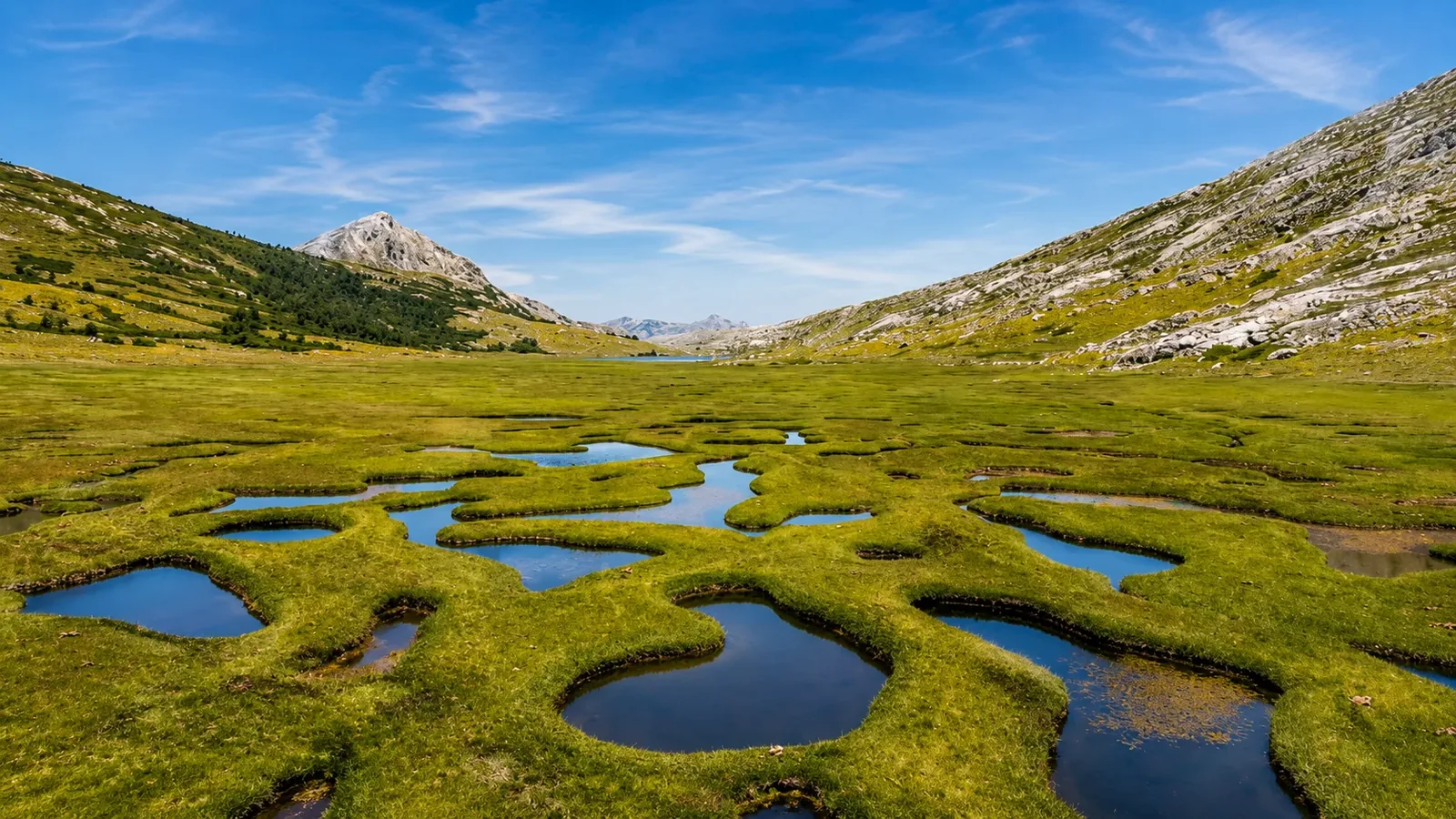
The day it clicked was the stage from Castel di Vergio to Petra Piana: 24.8 km, 11 hr 39 min door to door, 9 hr 26 min of it actually walking. I crossed the Nino pozzines somewhere in the middle of those eleven hours, and it took a long stop facing the Melo and Capitello lakes before my body agreed to move again. On the 16-day schedule, that same section is walked in two days, with a night at the Vaccaghja bergeries. That is not a luxury; it is a different traverse altogether.
Three days later we gave up on pushing through to Croci — our bodies had made the call before we did. What you underestimate beforehand is never one particular stage; it is the accumulation: the early starts stacking up, the punishing descents, the pack. If this is your first traverse, those four extra days are not an admission of weakness. They are clear thinking, and probably more enjoyment than I got out of some of my evenings.
The stages
The detailed stage table
Distance, elevation gain, estimated walking time and difficulty for each day. These are exactly the figures our planner computes, from the OpenStreetMap track of the GR20. Times here assume a relaxed (discovery) pace and a moderate (~11 kg) pack — adjust to your own profile in the planner.
| Day | Stage | Distance | D+ | D- | Time | Diff. |
|---|---|---|---|---|---|---|
| 1 | Calenzana → Ortu di u Piobbu | 10.9 km | +1,380 m | -130 m | 6h16 | 5/5 |
| 2 | Ortu di u Piobbu → Carrozzu | 7.3 km | +620 m | -890 m | 3h49 | 3/5 |
| 3 | Carrozzu → Ascu Stagnu / Haut-Asco | 4.9 km | +760 m | -570 m | 3h24 | 3/5 |
| 4 | Ascu Stagnu / Haut-Asco → Tighjettu | 8.3 km | +1,160 m | -920 m | 5h25 | 4/5 |
| 5 | Tighjettu → Castel di Vergio | 14.8 km | +710 m | -960 m | 5h56 | 4/5 |
| 6 | Castel di Vergio → Bergeries de Vaccaghja | 14.4 km | +580 m | -400 m | 5h17 | 4/5 |
| 7 | Bergeries de Vaccaghja → Petra Piana | 10.4 km | +860 m | -580 m | 5h02 | 4/5 |
| 8 | Petra Piana → Onda | 9.8 km | +440 m | -890 m | 3h59 | 3/5 |
| 9 | Onda → Vizzavona | 10.2 km | +650 m | -1,120 m | 4h43 | 3/5 |
| 10 | Vizzavona → E Capannelle | 13.8 km | +940 m | -270 m | 5h57 | 4/5 |
| 11 | E Capannelle → Bocca di Verde | 12.9 km | +280 m | -610 m | 4h14 | 3/5 |
| 12 | Bocca di Verde → Prati | 4.8 km | +550 m | -40 m | 2h36 | 3/5 |
| 13 | Prati → Usciolu | 10.9 km | +640 m | -700 m | 4h40 | 4/5 |
| 14 | Usciolu → I Croci | 13.9 km | +380 m | -600 m | 4h44 | 3/5 |
| 15 | I Croci → Foce di Bavedda / Col de Bavella | 17.5 km | +770 m | -1,090 m | 6h50 | 5/5 |
| 16 | Foce di Bavedda / Col de Bavella → Conca | 17.7 km | +430 m | -1,390 m | 6h11 | 4/5 |
| Total | 16 stages | 182.4 km | +11,220 m | -11,250 m | 79h00 |
How to read these numbers? The time shown is an estimated walking time (excluding breaks) for an average pace; on the trail, add stops, meals and weather. The D+ / D- are rounded, smoothed GPS values: the total track distance stays 182.4 km.
Watch out
A pace with no extreme day
Good news: on this split, no stage crosses the "very hard" threshold. The days stay mountainous, but the effort is better spread out, which limits the risk of dropping out from fatigue.
Accommodation
Where to sleep on this route
The 15 nights of this split, from start to finish. Book the Park refuges early in season — details, contacts and prices on our GR20 accommodation page.
- Night 1 Ortu di u Piobbu 1540 m
- Night 2 Carrozzu 1262 m
- Night 3 Ascu Stagnu / Haut-Asco 1443 m
- Night 4 Tighjettu 1679 m
- Night 5 Castel di Vergio 1408 m
- Night 6 Bergeries de Vaccaghja 1589 m
- Night 7 Petra Piana 1857 m
- Night 8 Onda 1400 m
- Night 9 Vizzavona 941 m
- Night 10 E Capannelle 1617 m
- Night 11 Bocca di Verde 1291 m
- Night 12 Prati 1811 m
- Night 13 Usciolu 1750 m
- Night 14 I Croci 1538 m
- Night 15 Foce di Bavedda / Col de Bavella 1218 m
Your way
Adapt this itinerary to your level
This split is a balanced starting point. In the planner you can change the duration, the direction (North-South or South-North), your pace and your pack: the stages, distances, times and difficulty recompute live, and you can download the GPX track for each day.
Level required
Who this pace is for
The right split depends above all on your mountain experience and your preparation. Here, honestly, is who this format suits.
Motivated beginner
Feasible with good preparation and a light pack.
Regular hiker
The ideal format to discover the whole GR20 calmly.
Group or sporty family
The pace that lets everyone keep up.
Photography / contemplation
Shorter days to truly enjoy the sites.
Methodology
How we calculate these numbers
Compare
Other durations and variants
This pace isn't for you? Compare it with the other GR20 splits — each page details its stages, elevation gain and difficulty.
Keep going